The History of Ping-Pong

All About Table Tennis
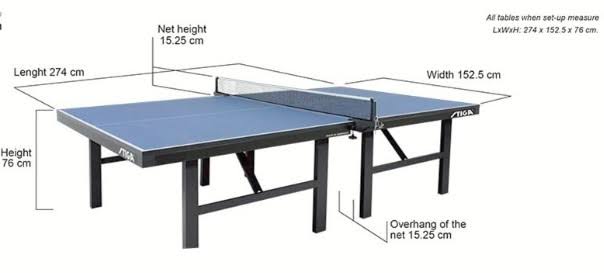
Like most other sports, table tennis had humble beginnings as a “parlor game,” open to anyone with access to a table, paddle, and ball. The game began in the 1880s, when lawn tennis players adapted their game to play indoors during the winter.

Ping-Pong is a trademark name for table tennis and associated equipment. The name “Ping-Pong” was invented by the English firm J. Jaques and Son at the end of the 1800s and later trademarked in the United States by Parker Brothers, the board game company.

The game quickly caught on, and as early as 1901, tournaments were being conducted with over 300 participants. The Ping-Pong Association was formed but was renamed The Table Tennis Association in 1922.

In 1902 a visiting Japanese university professor took the game back to Japan, where he introduced it to university students. Shortly after, a British salesman, Edward Shires, introduced it to the people of Vienna and Budapest, and the seeds were sown for a sport that now enjoys popularity all over the world. In Britain, table tennis had also begun to spread outside the distinctly middle-class confines of London, and leagues sprang up in provincial towns as far apart as Sunderland and Plymouth. In 1922, an All England Club was formed, which boasted such luminaries as Jack Hobbs the cricketer and other famous names of the time from the world of sport. The Daily Mirror organized and sponsored a nationwide tournament in which there were 40,000 competitors.

Table tennis was firmly on the map, and on April 24, 1927, the English Table Tennis Association was born, under the chairmanship and direction of Ivor Montague, son of Lord Ewatthling. He was not only to become the architect of modern-day table tennis, but he also achieved critical acclaim as both a director and film producer. At the time, The ETTA had a membership of 19 leagues but now has over 300, with around 75,000 registered players.

The first world championships were held in 1927 and were won by a Hungarian, Dr. Jacobi. Apart from the famous Fred Perry redressing the balance for England in 1929, this was to be the start of an unprecedented run of success for the Hungarians, who completely dominated the game throughout the thirties. Their team was led by the legendary Victor Barna, whose inspiration and skill did so much to elevate the game to sports status.

The 1950s saw the game turned upside down by the invention of the sponge or sandwich rubber, this new material for bats, which, up until now, had been a relatively simple affair with a universal thin covering of pimpled rubber.

Until this time, spin had played only a minor part in a game that had been dominated by the defensive style of play. But these new bats or paddles, introduced by the Japanese, had the capacity to move the ball around in an almost magical way. The ITTF, the game’s governing body, was quick to legislate in a bid to control this new development, seen in some quarters as equipping players with an unfair advantage. The thickness of the sponge and rubber sandwich was controlled and remains so to this day. But the nature of the game had been changed, establishing the fast attacking speed and spin style of the modern game.

Today, the sport both in England and abroad is very well established and is growing each year. The culmination of this has been its recognition as an Olympic Games sport, being featured for the first time in the 1988 games in Seoul. Television coverage of the men’s singles final attracted an incredible worldwide audience of 2 billion. In China, the game is played by literally millions at work, in school, and in community parks. Chinese top players are regarded as national heroes with pop star statuses.
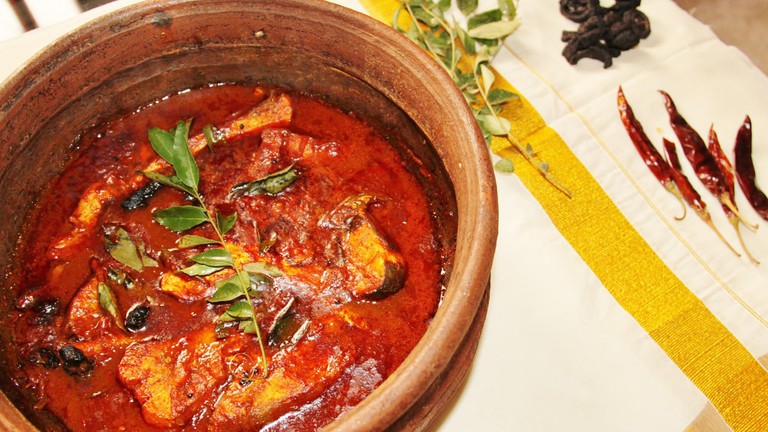
6 Traditional Dishes To try in Kerala, India

Known for its rich and generous use of coconut and rice, traditional Kerala cuisine is not to be missed. Bursting with flavours and rife with textures, the classic recipes from this southern state on the western coast of India have a huge fan following. Here are 11 time honoured dishes from Kerala, in no particular order, which have formed the culinary identity of the state.

Puttu and Kadala Curry

A widely favoured combination, Puttu and Kadala curry is a common vegetarian breakfast savoured in homes and restaurants alike, across Kerala. Puttu is made of rice powder mixed with coconut and water, which is then steamed in cylindrical steel or coconut shaped mould. Kadala curry is a mildly spicy curry of black chickpeas cooked in thick, aromatic coconut gravy. The combo is easy to cook and therefore forms a go-to recipe for a quick and healthy breakfast.

Appam

Yet another delicacy made of rice powder, these hoppers are a favoured component of meals that can be enjoyed any time – breakfast, lunch, or dinner. Appam can be combined with vegetarian gravies such as stew, and can also be a classic sidekick for non-vegetarian fare such as chicken curry, mutton, and Kerala’s favourite, beef. Best when devoured fresh, appam can lose its taste as it cools down.

Pathiri

A specialty from the Malabar region in North Kerala, this is a part of the famous Moplahcuisine of the Muslims of Kerala. It is a thin round pancake made from rice flour, and is eaten in combination with curries, primarily non-vegetarian curries such as chicken and mutton. Like appam, it can be consumed at any time of the day, and requires a spicy or flavourful curry to go with its otherwise bland taste.

Malabar Chicken Biryani

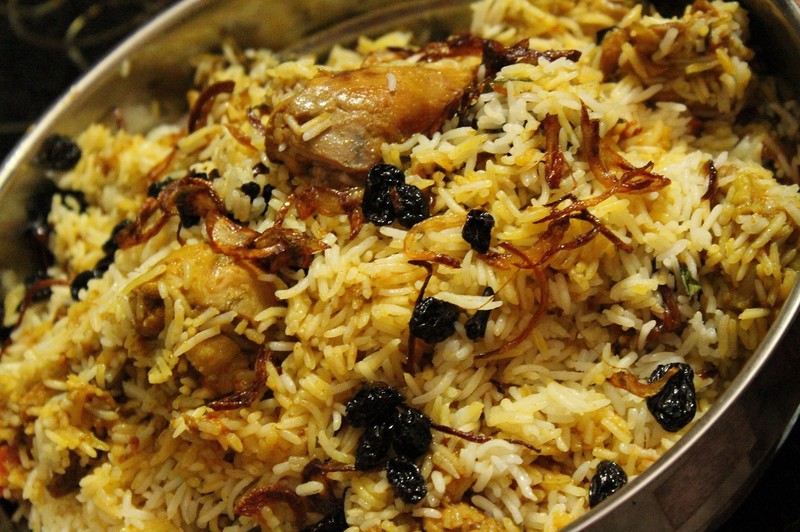
Undoubtedly one of the mass favourites of Keralites, this dish has transcended its geographical origins to cement its place in the hearts of Malayalis from all across the state. This biryani is characteristic for its intense flavours that are obtained from a whole host of aromatic spices. The biryani is a complete meal that can be had at lunch or dinner. Biryani’s variations are present all across the country, and in different forms. Just add a kick of salad or raita to go with it.

Avial

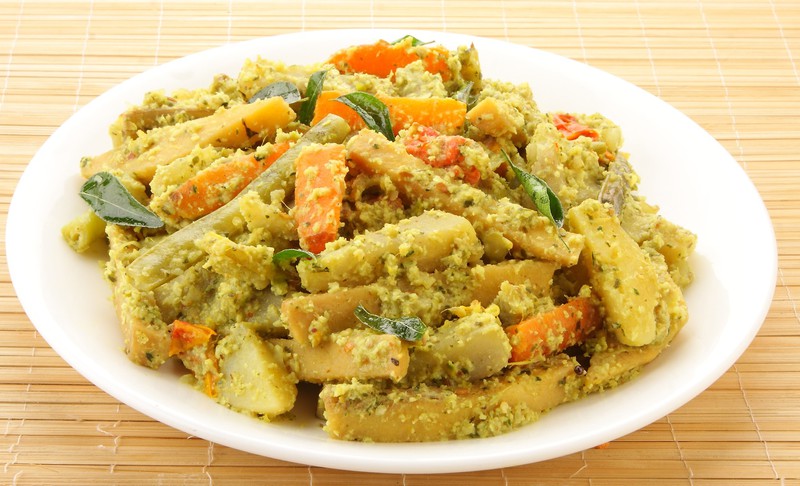
One of the healthiest vegetarian dishes, Avialis made with mixed vegetables cooked in a paste of ground coconut and flavoured with coconut oil. It is an imperative component of the traditional Kerala feast, called sadya. This is a thick and dry dish and is eaten with rice. One of the interesting stories behind the origin of the dish is that it was created by the character of Bhima from Hindu mythology, who, upon being forced to cook during his exile, chopped up whatever vegetables he could find and then cooked them together.

Banana Chips

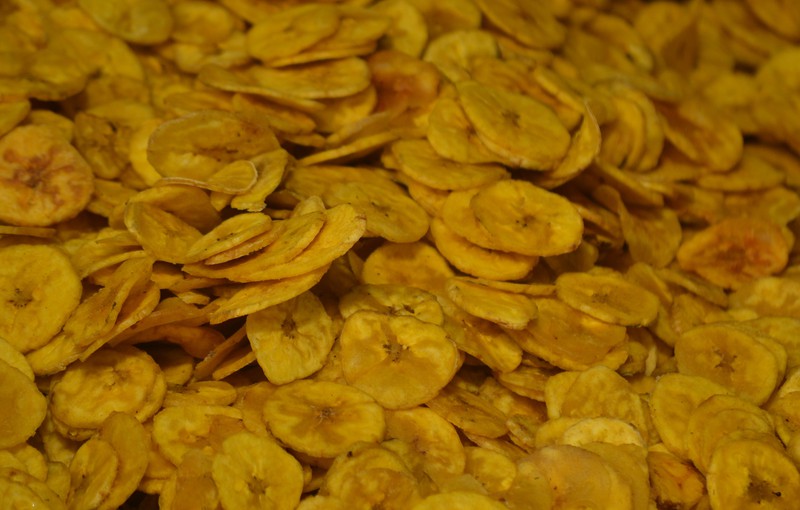
One of the most common snacks found throughout the length and breadth of Kerala, the banana chips are a favourite among Malayalis as well as people from outside. These golden and crunchy chips are made from raw plantains which are thinly sliced, left to dry in the sun, and then deep fried. A common sight in street shops all over the state, it is one of the most popular tea-time snacks served at homes and restaurants around Kerala.

Life is a roller coaster ride ….


Well , we are just a bunch of children , who thought of writing and dealing with some of the happy ,inspirational and , almost tear jerking incidents in our flamboyant and fabulous lives !!!!!!!

An inspirational aspect of our teenage lives
Well, this is my personal story which, happened to me after 9th standard. I used to be one of the top 3 students of my class. Well, one day when I was walking with the 1st student of our class, he had mocked me by saying that, even though I study so much, I still don’t get better marks than him.

I had felt very hopeless, and angry after hearing that statement. So, I decided to study hard to beat him. I studied really hard, day and night. But I still lost ………in fact I lost so badly, that my current rank went down several ranks below my previous rank.

It was at that moment that I realized that I was inspired by the wrong thing. I should have quietly kept on studying and, instead of trying to beat him, I should have tried to beat myself.

It was my anger that had stopped me from getting a better rank, because, if we let our own feelings control us , then we can’t perform well .

Reasons drive every person. The pain we feel when someone says that you can’t do it, was my sole inspiration.

The sad aspects of our teenage lives


The following things were said to us by a teenager who had suffered through one of the common yet unsaid problems in a teenager’s daily life ‘DEPRESSION’———-

“Maybe if my leg was broken, or if I was diagnosed with a life-threatening disease, they would have cared more. It seems that mental illness has no place in this world.

Sometimes, I feel like crying and, sometimes laughing hysterically (yeah, this is abnormal for older people), but I am not the only one suffering from this condition, called as ‘DEPRESSION’. Well, at least 1 in 3 Indian teenagers suffer from this.

I know that I can be stronger, and fight my depression, so imagine the sadness I fell when people call me a faker. People say that ‘sticks and stones may break my bones, but words will never hurt us’. But the emotional scars are left with us.

This makes me feel bad for all the times that, I have been mean, and acted like a bad person to others.”

The Stress aspects of a Teenage Life

Teens are under more stress today than ever before. Sound like an exaggeration? Despite the fact that I am often prone to hyperbole, consider this: being a teenager is not easy.

Adolescence has always been a tricky developmental period defined by fundamental yet somewhat difficult changes (physical, cognitive, and social) experienced by teens as they make their way from childhood toward adulthood. These transitions trigger changes in the way the teen sees him/herself, and the way that others see and treat him or her. They are no longer children, but not yet adults, and this series of transitions not only has an impact on the individual experiencing the transitions, but also on parents, peers, and society as a whole.

Some teenage quotes ——


“All is well that ends well…and if it is not well, it’s not the end…the story is not yet over, my friend!”

― A teenage kid


“To be a great teenager you need not sit like a rock but work like a clock for life is not a game but a challenge you must win.”

― another teenager


“All of us are confused and we don’t know what lays ahead of us….we can just wait and see as our lives take an interesting and adventurous turn….”

—- “Teen”ager